Shadowbinding
A Clash of KingsShadowbinding is a form of shadow magic associated with Melisandre, the red priestess of R’hllor. Its decisive function is assassination: it converts the shadow of a living man into a separate, weapon-bearing entity capable of passing through barriers and killing targets without an ordinary attacker being present. The practice therefore collapses the distinction between political will and supernatural agency. Stannis Baratheon may issue commands and benefit from the results, but the visible violence is performed by a shadow whose origin is both his and not his.
Definition and Practitioners
Melisandre is identified as a sorceress, shadowbinder, and priestess of R’hllor, the Lord of Light, the Heart of Fire, the God of Flame and Shadow. Maester Cressen regards her as the central danger on Dragonstone, fearing that her madness and influence might spread beyond the island. His description places Shadowbinding within a wider religious and magical system, but the evidence gives it a more concrete and disturbing expression than a mere doctrine: it is a practical power capable of producing a killer.
The nature of that power is suggested by the relationship between a shadow and the person who casts it. During Renly Baratheon’s murder, Catelyn Stark sees a shadow moving against the tent wall, lifting a sword while Renly’s actual sword remains sheathed. The attack is not presented as a normal blade strike or as an assassin hidden nearby. The shadow itself becomes the weapon, separating from the ordinary conditions of the body and making the darkness cast by a man into an independent agent.
Renly Baratheon’s Assassination
The first fully witnessed use of Shadowbinding occurs in Renly Baratheon’s tent. As Catelyn Stark pleads with him, a gust opens the door and the shifting shadow on the silken walls acquires an ominous, unnatural life. Renly’s sword stays in its scabbard, yet a second, shadow-made sword appears to rise. The visual contradiction is the key to the magic: the attack is both represented by a sword and detached from the physical sword that Renly could see or defend against.
Renly feels only cold before the steel of his gorget parts beneath a blade that is not there. He has time for a small gasp, then blood pours from his throat. Brienne of Tarth catches him as he collapses, while candles gutter and his green-and-gold armor is drowned in red. The scene makes the supernatural assault inseparable from the political consequence. Renly, the rival king whose army threatens Stannis Baratheon, dies inside a guarded tent without a conventional combatant delivering the blow.
The aftermath initially threatens Brienne of Tarth, because she is found beside the dead king and is mistaken for his killer. Catelyn Stark recognizes that the event cannot be explained by ordinary violence and tells Ser Robar Royce that Stannis Baratheon killed Renly through sorcery and dark magic. Her conclusion is based on the shadow she saw and on the absence of any credible physical attacker; it turns a bewildering murder into the first clear political application of Shadowbinding.
Stannis Baratheon and Prophecy
Stannis Baratheon later confirms that Melisandre had foreseen Renly Baratheon’s doom in the flames. She had warned Stannis that going to Storm’s End would allow him to win the greater part of his brother’s power, and Renly’s death produces exactly that advantage. Stannis also recalls a possible future in which Renly, wearing green armor, would have ridden north from the south and crushed Stannis’s host beneath the walls of King’s Landing. In this account, Shadowbinding is presented not as an isolated marvel but as the means by which a prophetic warning becomes political reality.
Stannis tells Davos Seaworth that Ser Cortnay Penrose will die within the day and that Melisandre has already seen both his death and the manner of it. He specifies that Penrose will not die in knightly combat. The statement links the earlier killing to the coming one and establishes recurrence as part of Shadowbinding’s threat: a single supernatural assassination might be dismissed as an aberration, but Melisandre’s predictions and Stannis’s confidence imply a repeatable method.
The relationship between Stannis and the magic remains morally and physically ambiguous. Stannis claims that Melisandre’s flames do not lie and acknowledges that Renly’s death was advantageous to him, yet Davos Seaworth’s hesitation exposes the gap between political benefit and human responsibility. Stannis does not describe himself as personally striking his brother; instead, he treats the foreseen death as the consequence of Renly’s decision to come to Storm’s End. Shadowbinding thus provides a language of fate and necessity through which murder can be accepted as both supernatural fulfillment and royal strategy.
The Shadow’s Birth
Davos Seaworth encounters the most explicit manifestation of Shadowbinding beneath the castle. In the darkness, Melisandre throws back her cowl and removes her robe, revealing herself naked and hugely pregnant. Her eyes resemble hot coals, and the sweat on her skin seems to glow. The image first resembles an impossible childbirth, but the body being delivered is not human in any ordinary sense.
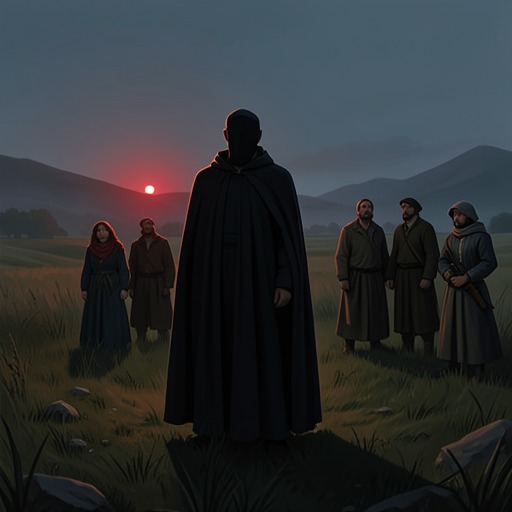
Melisandre squats and gives birth to a black shadow. Blood runs down her thighs, and the crown of the child’s head emerges before two arms push free, their black fingers curling around her legs. The entire shadow slides into the world, rises taller than Davos Seaworth and as tall as the tunnel, then twists through the bars of the portcullis and races across the water. The sequence supplies a physical origin for the killer seen at Renly Baratheon’s death: Shadowbinding is not merely the manipulation of darkness but the generation of a living or quasi-living assassin from Melisandre’s body.
Davos Seaworth recognizes the shadow and recognizes the man who cast it. The scene therefore preserves a connection between the created creature and Stannis Baratheon even while separating them in form. The shadow can move independently, cross a barrier that blocks a boat, and vanish into the world, but it remains tied to the identity and power of the king whose shadow it is. That double status—offspring and weapon, independent body and reflected self—makes the magic especially unsettling.
Consequences and Significance
Shadowbinding changes the scale of political violence in the War of the Five Kings. A siege, a battlefield, or a guarded royal tent might ordinarily impose limits on assassination, but the shadow bypasses those limits. Renly Baratheon’s armor, guards, and enclosed tent offer no protection, while Ser Cortnay Penrose’s expected death is announced before it occurs and explicitly separated from knightly combat. The practice turns access, distance, and defense into uncertain quantities.
Its horror also depends on delayed recognition. At first, Renly’s death appears to be a crime committed by the people closest to him; only Catelyn Stark’s perception of the impossible shadow reveals the supernatural mechanism. The narrative makes the reader witness effects before receiving a complete explanation, allowing political confusion and physical terror to merge. When Davos Seaworth later sees the shadow being born, the earlier mystery is not reduced to a tidy rule. Instead, the explanation becomes more bodily, more grotesque, and more difficult to classify.
The imagery repeatedly joins beauty to violation: a shadow moves like a sword across green silk, candles tremble around a dying king, and the newborn creature seems to shine only because it emerges from Melisandre’s fiery, sweating body. This contrast gives Shadowbinding a distinctive symbolic force. It promises Stannis Baratheon victory through a power associated with light and prophecy, yet its actual products are concealment, blood, and a faceless killer. The magic’s political efficiency is therefore inseparable from its capacity to corrupt ordinary ideas of combat, kinship, and responsibility.